
6. The door and the win
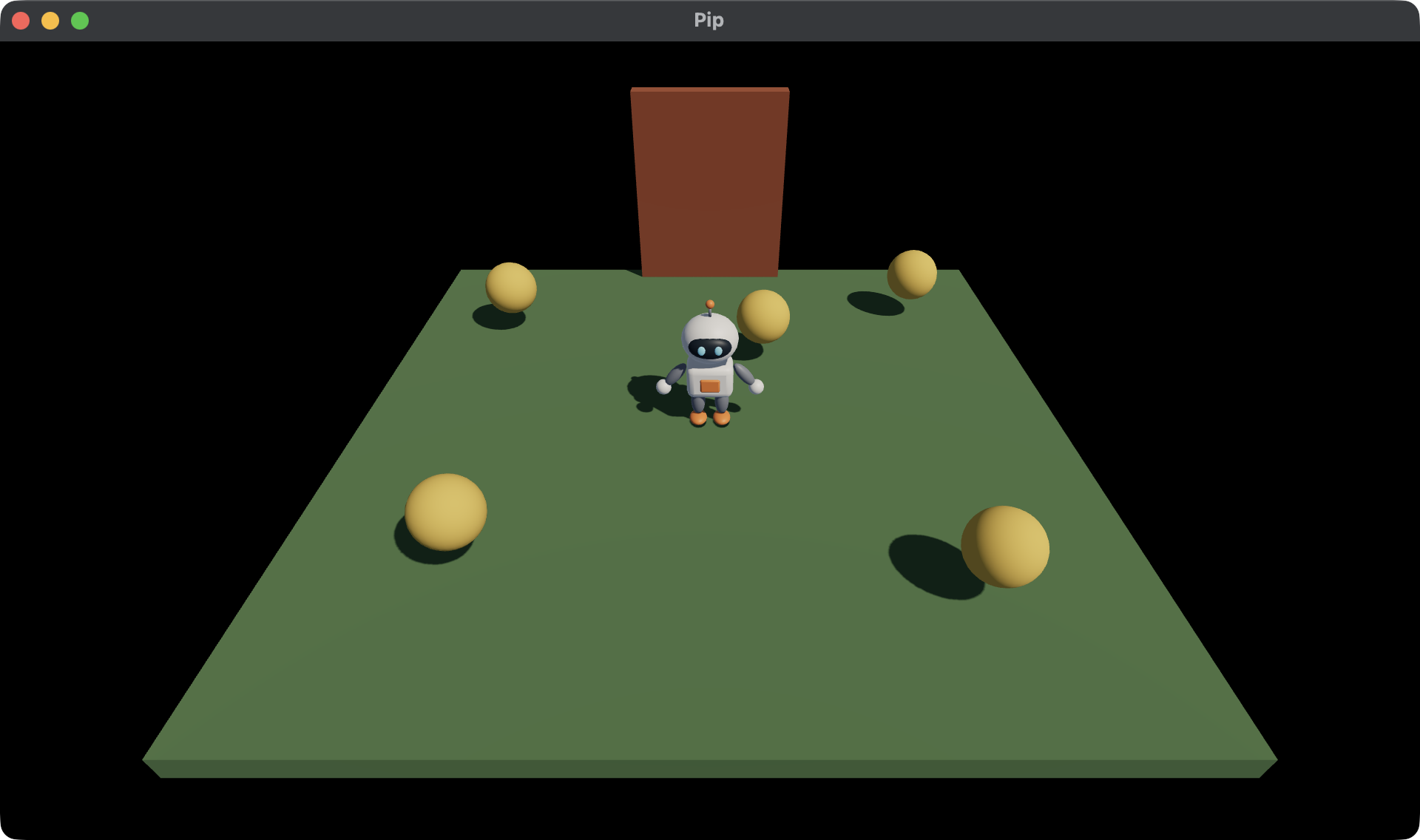
Pip collects pickups, but the game never ends. In this chapter, you add a door at the far edge of the ground. It stays shut until Pip collects every pickup. Then it rises, and Pip wins by walking into the doorway. You use:
- a phase in the Model, which tells
stepwhether the game is still on, - the
normalanddepthof a Contact, which push Pip out of the shut door, - the
QuitCommand, which stops the game when you press Escape.
The editor starts with your app from 5. Pickups. If you get lost, press Show answer to see the full app of this chapter.
The imports and pip.glb stay the same, and so does the header:
app [init, launch, loaded, step, view] { cam: "https://github.com/Pixelsprout/rocco-engine/releases/download/v0.16.0/camera-HVUJTSKzVcZVjTnxuZPa9hMFU65JwXUY14vqCGmk2f3p.tar.zst", linalg: "https://github.com/Pixelsprout/rocco-engine/releases/download/v0.16.0/linalg-91nNeJnp8hDsifhs6y1vmjLwQ3n5DPnfWtv6KvdVh8cv.tar.zst", mesh: "https://github.com/Pixelsprout/rocco-engine/releases/download/v0.16.0/mesh-7zFcKD4YWLEtnKqeAVRi6GH7zXKgL9fpVyzf4SdAx12y.tar.zst", pf: platform "https://github.com/Pixelsprout/rocco-engine/releases/download/v0.16.0/platform-7dtsuSpabi2sAHN4AKwgRzJjpBNfD6gsWkPJ4PWpZf5D.tar.zst", roc: "0.1.0-rc1" }The Model
The game has two phases: Pip is playing, or Pip has won. Add a Phase
type, and add the phase and the height of the door to the Model:
# id is the draw id of the pickup and of its Collider.
Pickup : { id : U64, pos : Vec3 }

Phase : [Playing, Won]

# pip is 0, the fallback mesh, until loaded gives its id.
# yaw turns Pip about +y. At 0, Pip faces +z.
# door_lift goes from 0, shut, to door_height, open.
Model : { cube : U32, sphere : U32, pip : U32, pos : Vec3, yaw : F32, pickups : List(Pickup), door_lift : F32, phase : Phase }
A tag union such as Phase names each phase of the game. step matches
on it, so each phase gets its own rules, and Roc checks that step
handles every phase.
Give the door an id. It is higher than Pip’s id, so Pip is still a in
each of its Contacts:
ground_id : U64
ground_id = 1

# Pip's id is lower than the id of every other Collider, so Pip is always `a`
# in a Contact.
pip_id : U64
pip_id = 2

door_id : U64
door_id = 3
The game starts in Playing, with the door shut:
init : Vocabulary.Config -> { model : Model, commands : List(Command) }
init = |_config| {
	model = { cube: Mesh.primitive(Cube), sphere: Mesh.primitive(Sphere), pip: 0, pos: V.zero, yaw: 0.0, pickups: start_pickups, door_lift: 0.0, phase: Playing }
	{ model, commands: [Load({ pack: "pip", assets: ["pip"] })] }
}
step
step now chooses its rules by the phase:
step : Model, Vocabulary.Input, Vocabulary.QueryResults, F32 -> { model : Model, commands : List(Command) }
step = |model, input, results, dt| {
	contacts = results.contacts
	next = match model.phase {
		Playing => collect(model, contacts) |> push_out(contacts) |> walk(input, dt) |> raise_door(dt) |> win(contacts)
		Won => spin(model, dt)
	}
	{ model: next, commands: quit_on_escape(input) }
}

quit_on_escape : Vocabulary.Input -> List(Command)
quit_on_escape = |input| if (Key.pressed(input, Escape)) [Quit] else []- While Pip plays,
stepruns the stages in order: collect the pickups, push Pip out of the door, walk, raise the door and check for the win. Each stage takes a Model and gives the next Model, so|>chains them. - After the win, Pip ignores the keys and spins.
- In each phase, Escape gives the
QuitCommand. The host gives no key a meaning, so the game must quit by itself.Key.pressedis true only in the step after Escape went down, so Quit goes to the host once.
The door
Here are the stages that the door needs:
door_height : F32
door_height = 2.0

# Units each second.
door_speed : F32
door_speed = 1.5

raise_door : Model, F32 -> Model
raise_door = |model, dt|
	if List.is_empty(model.pickups) {
		{ ..model, door_lift: F32.min(model.door_lift + door_speed * dt, door_height) }
	} else {
		model
	}

is_open : Model -> Bool
is_open = |model| model.door_lift >= door_height

# Until the door is open, it pushes Pip back out of the doorway. The normal
# points from Pip to the door.
push_out : Model, List(Contact) -> Model
push_out = |model, contacts|
	match List.find_first(contacts, |c| c.a == pip_id and c.b == door_id) {
		Ok(c) if !is_open(model) => {
			back = V.sub(model.pos, V.scale(c.normal, c.depth))
			{ ..model, pos: { ..back, y: 0.0 } }
		}
		_ => model
	}

win : Model, List(Contact) -> Model
win = |model, contacts|
	if is_open(model) and List.contains(touched(contacts), door_id) {
		{ ..model, phase: Won }
	} else {
		model
	}

# Radians each second.
spin_speed : F32
spin_speed = 4.0

spin : Model, F32 -> Model
spin = |model, dt| { ..model, yaw: model.yaw + spin_speed * dt }raise_doorlifts the door atdoor_speedonce no pickups are left. It stops atdoor_height, andis_openis true from then on.push_outkeeps Pip out of the shut door. A Contact’snormalpoints fromatob, so from Pip to the door, anddepthis how far the two shapes overlap. Moving Pip back along the normal by the depth takes Pip out of the door.winchanges the phase toWonwhen Pip touches the open door.spinturns Pip about +y after the win.
The Contacts are one step old, so Pip walks a little way into the shut
door before push_out moves it back. At 120 steps each second, the
overlap is too small to see.
view
view draws the door and gives it a Collider:
# The door stands at the far edge of the ground.
door_half : Vec3
door_half = { x: 0.8, y: 0.5 * door_height, z: 0.1 }

door_pos : Vec3
door_pos = { x: 0.0, y: door_half.y, z: -2.9 }

view : Model -> Vocabulary.Scene
view = |model| {
	ground = { ..Draw.default, id: ground_id, mesh: model.cube, pos: { x: 0.0, y: -0.1, z: 0.0 }, scale: { x: 6.0, y: 0.2, z: 6.0 }, tint: { r: 0.12, g: 0.25, b: 0.1 } }
	pip = { ..Draw.default, id: pip_id, mesh: model.pip, pos: model.pos, rot: Quat.from_yaw(model.yaw) }
	door = { ..Draw.default, id: door_id, mesh: model.cube, pos: { ..door_pos, y: door_pos.y + model.door_lift }, scale: V.scale(door_half, 2.0), tint: { r: 0.45, g: 0.12, b: 0.05 } }
	pickups = model.pickups.map(|p| Draw(pickup(model.sphere, p)))
	camera = Cam.look_at({ x: 0.0, y: 3.6, z: 4.8 }, { x: 0.0, y: 0.0, z: 0.3 })
	# The box's centre is half its height up, so it stands on Pip's feet.
	pip_box = Collider.box(pip_id, { ..model.pos, y: pip_half.y }, Quat.from_yaw(model.yaw), pip_half)
	# The doorway keeps its Collider while the door rises.
	door_box = Collider.box(door_id, door_pos, Quat.identity, door_half)
	colliders = [Collider(pip_box), Collider(door_box)].concat(model.pickups.map(|p| Collider(Collider.sphere(p.id, p.pos, pickup_radius))))
	queries = [Query.contacts_of(pip_id)]
	nodes = [Light(sky_light), Light(sunlight), Draw(ground), Draw(pip), Draw(door)].concat(pickups).concat(colliders)
	{ ..Scene.empty, camera, nodes, queries }
}
The door’s Draw rises by door_lift, but its Collider stays in the
doorway. So the same Collider stops Pip while the door is shut and wins
the game once it is open. The door is a cube, like the ground, so it uses
model.cube.
See the game
The Preview runs your game. If you turned auto-run off, press Run. Click the Preview to give it the keys.
Collect every pickup. The door rises. Walk Pip into the doorway, and Pip spins. Press Escape to quit.
You can’t yet see how many pickups are left, or that you have won. Next, read 7. A HUD. It puts the count and a message on the screen.